

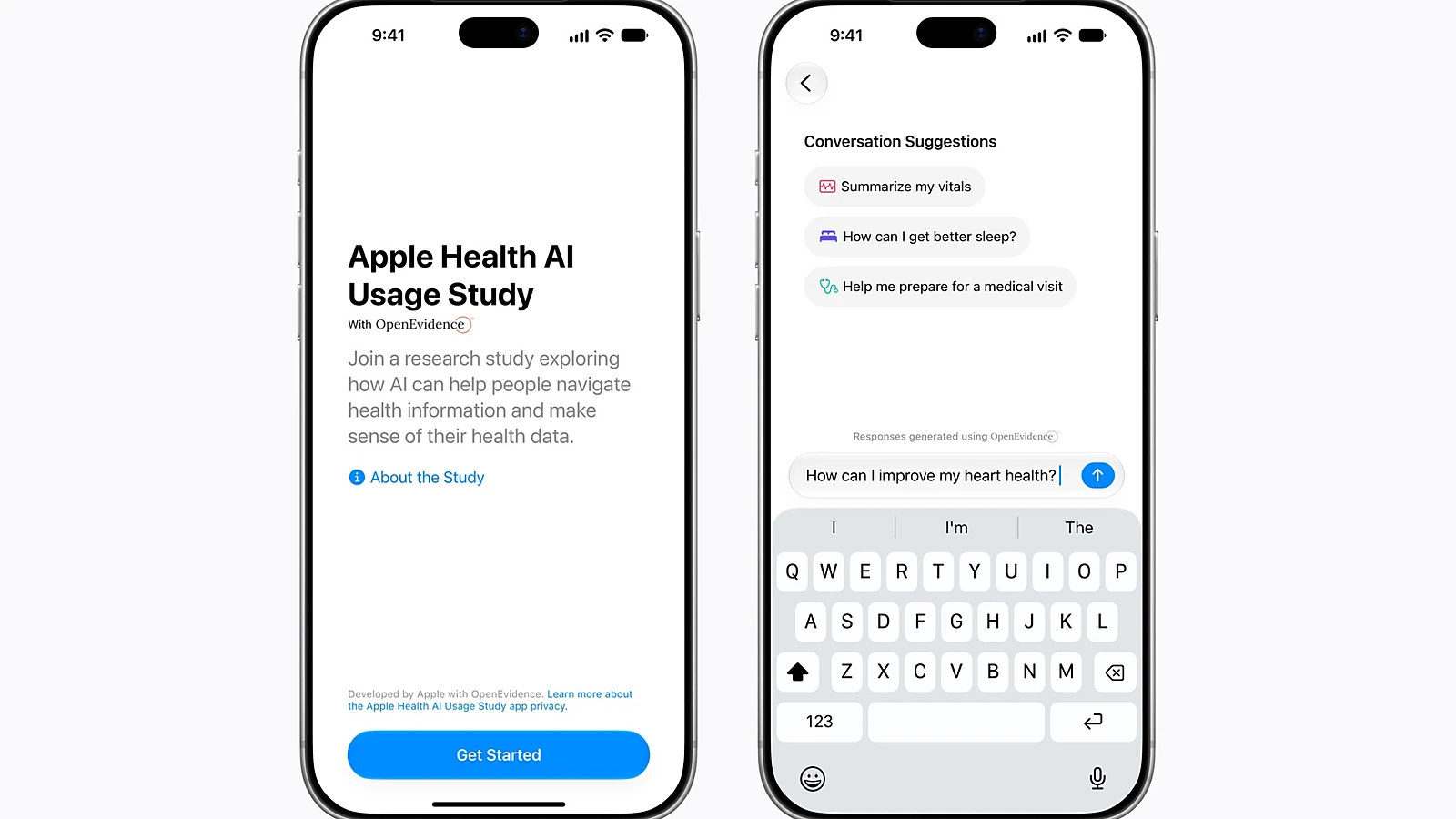
Apple has launched the Apple Health AI Usage Study, a virtual research study in the United States that looks at how people use chatbots for health questions. Announced on 15 November 2026 and run together with clinical AI company OpenEvidence, the study is open to up to 200,000 adults, who take part through a dedicated iPhone app.
The details
Apple says the aim is to learn what makes people trust a health AI tool, how good its answers are, how well people understand them, and whether they lead to everyday health actions. The company says the results will shape how it designs health AI features, and that it wants them to inform the wider industry too.
The answers in the study app come from OpenEvidence, a platform already used by many doctors and nurses. It builds its replies from established medical publications, and Apple names The New England Journal of Medicine, the Journal of the American Medical Association and Nature as examples. Apple designed the research experience around it. Inside the app, participants can:
- ask ordinary health questions;
- read complicated medical topics explained in plainer language;
- see links to the peer-reviewed clinical papers behind each answer;
- choose to share HealthKit data, such as resting heart rate, activity, sleep or lab results, so researchers can see whether personal data makes answers more relevant and easier to follow.
The study will also look at whether a health AI tool can help people get ready for appointments with their own doctors. Apple notes that chatbots built on large language models can sometimes give answers that are incomplete or unclear, and presents the study as a way to find clearer ways of showing health information.
"Health is deeply personal, and conducting a dedicated research study is the most thoughtful way"Sumbul Desai, M.D., vice president of Health and Fitness, Apple
Who gets it and when
Enrolment is open now through the study app on the App Store. To take part, a person must:
- live in the United States;
- be 21 or older;
- own an iPhone that supports Apple Intelligence, which means an iPhone 15 Pro or a later model;
- run iOS 26 or later.
Apple caps the study at 200,000 participants. It has not announced plans for other countries.
Privacy and safety
Apple says the study was built with privacy protections, transparency and clinical safeguards from the start. Its main commitments:
- No model training: data gathered in the study will not be used to train AI models.
- Participant control: people decide whether to share any HealthKit measurements or survey answers.
- Guardrails: the app is meant to spot some worrying questions and point the person to a provider or other help.
- Not a medical service: the app does not diagnose or treat any condition and is not a replacement for a doctor's advice.
"Patients and clinicians are both turning to AI, but the tools they use are being built and tested in separate worlds,"Robert M. Wachter, M.D., professor and chair of the Department of Medicine, UCSF
What is still unknown
Apple has not said how long the study will run, when or how it will share the findings, or whether any of the tools tested in the app will later become part of its own products. Earlier this month Apple opened Siri's AI features to outside developers (our report). For a plain introduction to AI assistants, see our beginner's guide.
Announced by Apple on its official Newsroom: read the announcement